
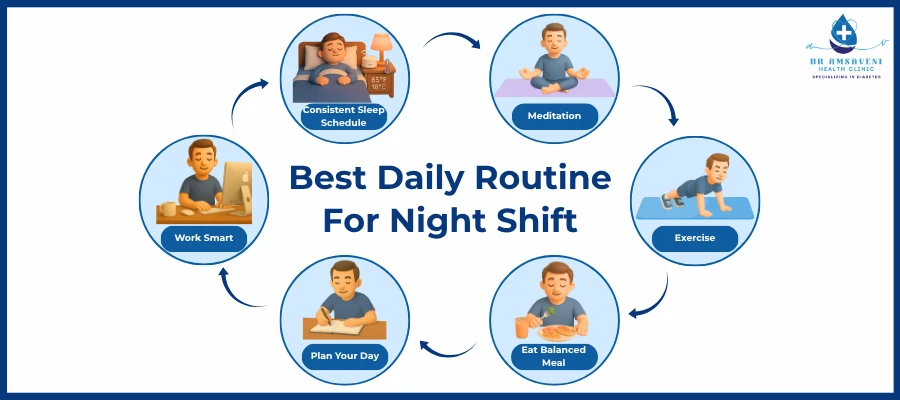
9 Easy NightShiftLiving Health Routines After Night Shifts
>> Health NightShiftLiving>> 9 Easy NightShiftLiving Health Routines After Night Shifts
9 Easy NightShiftLiving Health Routines After Night Shifts
You just had a long night shift. Your feet hurt. Your eyes are dry. Your brain feels like two bars of battery. You don’t want to think about a “health routine.”
But here’s the thing — what you do in the hours after your shift is over can make or break how you feel for most of the rest of your day. And day by day, and week by week, those choices equal a healthier you or a burned-out version of yourself.
The good news? NightShiftLiving health habits don’t have to be complicated. You don’t need a gym membership or a nutrition degree. All you need are nine simple, science-backed habits that work in your real life as a night shift worker.
Those numbers are sobering. But they’re also avoidable if you have the right NightShiftLiving habits in place. The body is pretty great at healing — as long as you give it what it needs to do so.
Post-Shift Recovery — The Most Neglected Aspect of Night Shift Work
Most night shift advice is about how to make it through your shift — caffeine, light exposure, power naps. That’s all useful. But what takes place on the far side of the shift is just as necessary.
Your body is in a state of stress when you come off a night shift. Cortisol levels are elevated. Your digestive system is sluggish. Your muscles are stiff. Your eyes are strained from the artificial light. Your brain works hard fighting against your natural body clock.
The body never gets to reset without a recovery routine. That stress builds day after day into something far more difficult to dispel.
NightShiftLiving health habits after each shift act like a reset button. It signals your body: “The work is finished. Time to heal.”
What Happens to Your Body After a Night Shift (Without Recovery)
Cortisol (stress hormone)
High
Melatonin production
Low
Digestive activity
Sluggish
Muscle tension
Elevated
Mental alertness
Depleted
Your 9 NightShiftLiving Health Routines at a Glance
01
Decompress Before You Drive
02
Hydrate the Right Way
03
Eat a Recovery Meal
04
Move Your Body Gently
05
Shield Your Eyes From Light
06
Take a Transition Shower
07
Do a Mental Wind-Down
08
Protect Your Sleep Window
09
Check In With Yourself
Routine 1 — Unwind Even Before You Leave the Building
Most night shift workers run out the door the moment their shift is over. That’s valid — you’re tired and you want to go home. But spending 5–10 minutes just before you leave decompressing can significantly alter your body’s recovery time.
The Importance of the First 10 Minutes
The second your shift is over, your nervous system is still in “work mode.” Your heart is racing a little. You’re still processing what happened that night. Hopping into a car or a hectic commute keeps that stress response going.
A brief decompression period — even just sitting still for a few minutes — allows your nervous system to grant itself permission to begin the wind-down process.
- Find a quiet place and take five deep, slow breaths
- Do a quick 2-minute body scan — notice where you’re tense (jaw, shoulders, hands)
- Write down something you did well during the shift
- Drink a glass of water before getting into your car or heading to your commute
NightShiftLiving Quick Win
Keep a mini journal in your locker or bag. Listing three quick notes at the end of each shift — what went well, what was hard, and one thing you’re looking forward to — reduces cortisol and allows you to leave work mentally at work.
This simple habit creates the framework for everything else that follows. It is the foundation of a solid NightShiftLiving post-shift routine.
Routine 2 — Drink Smarter, Not Just More

By the end of a shift, nearly all night shift workers are dehydrated. You’ve been on your feet for hours, working under glaring artificial lights, sipping coffee and probably not drinking enough water through the night.
Dehydration Hits Harder at Night
Your body is losing water even while you’re simply breathing. Throw in movement, stress, caffeine and the dry air-conditioned environment, and by the time your shift is over you’re looking at some serious fluid loss.
Mild dehydration — only a 1–2% loss of body fluid — leads to headaches, brain fog, irritability and muscle cramps. All things that night shift workers know all too well, and often attribute to the shift itself.
| Hydration Level | How You Feel | What to Do |
|---|---|---|
| Well hydrated | Clear urine, alert, no headache | Maintain with regular sips |
| Mildly dehydrated (1–2%) | Dark urine, slight headache, tired | Drink 500ml water immediately |
| Moderately dehydrated (3–4%) | Headache, dizziness, poor focus | Water + electrolytes, rest |
| Severely dehydrated (5%+) | Confusion, rapid heartbeat, nausea | Seek medical attention |
Here’s a simple NightShiftLiving hydration rule: drink 500ml (about 17oz) of water within 30 minutes of ending your shift. Then keep sipping throughout your morning. Don’t chug — sip steadily.
Hydration Upgrade
Try adding a tiny pinch of sea salt and a squeeze of lemon to your post-shift water. This makes for a natural electrolyte drink that allows your body to absorb water much more effectively than plain water alone.
Stay away from alcohol as a wind-down drink. It can feel relaxing but it causes further dehydration and breaks up your sleep, reducing the quality of your recovery. Herbal tea or warm water with honey is a much better choice for NightShiftLiving recovery.
Routine 3 — Give Your Body a Proper Recovery Meal
What you eat after a night shift is one of the most potent tools in your NightShiftLiving health toolbox. After a long night, your body is in repair mode. Give it the right food and it heals quickly. Feed it junk and that stress and inflammation drags on longer.

The Post-Shift Recovery Plate
You don’t need an elaborate meal. You need something that checks all three of these boxes:
- Protein — rebuilds muscle tissue and balances blood sugar. Aim for 20–30g.
- Complex carbohydrates — restores energy reserves without spiking insulin
- Anti-inflammatory foods — helps clear the oxidative stress that has accumulated overnight
| Food Category | Best Options | Why It Helps |
|---|---|---|
| Protein | Eggs, Greek yogurt, canned tuna, cottage cheese, tofu | Repairs tissue, stabilises energy |
| Complex carbs | Oatmeal, whole grain toast, sweet potato, brown rice | Slow energy release, supports serotonin |
| Anti-inflammatory | Berries, leafy greens, turmeric, ginger, walnuts | Reduces cortisol-related inflammation |
| Sleep-supportive | Kiwi fruit, tart cherry, banana, almonds, warm milk | Naturally boosts melatonin and magnesium |
| Avoid | Fried food, sugary cereals, alcohol, large portions | Spikes insulin, disrupts sleep, raises cortisol |
Common Mistake
Many night shift workers skip eating after their shift because they’re too tired to cook. But going to bed on an empty stomach leads to fragmented sleep, early waking from hunger, and blood sugar crashes. A small, healthy snack is always better than nothing.
The secret weapon here is meal prep. Carve out 30 minutes on your day off to stock up on grab-and-go recovery meals. A jar of overnight oats, a couple of boiled eggs, or a smoothie pack in the freezer eliminates decision fatigue when it comes to eating after your shift — and is a core part of good NightShiftLiving planning.
Routine 4 — Move Your Body (Yes, Even Now)
This one will catch most night shift workers off guard. Exercise? Right after a 10-hour shift? But hear this out — gentle movement after a shift is one of the most potent recovery tools known to sports science.
The Difference Between Exercise and Movement
There’s a world of difference between hitting the gym for an intense workout (not good immediately after a shift) and getting in 10–15 minutes of gentle movement (absolutely positive). We’re talking about the latter.
After a long night, your blood has pooled in your lower body. Your lymphatic system — which clears away waste from your cells — has slowed down. A brief walk or gentle stretch engages both of those systems, clearing away the biological “waste” that accumulated during the shift.
- A 10-minute leisurely stroll around the block
- 5 minutes of gentle yoga or stretching
- Foam rolling tight muscles (lower back, calves and shoulders)
- Light cycling on a stationary bike at a conversational pace
Post-Shift Movement — Time vs Benefit
5 min stretch
Good
10 min walk
Great
15 min yoga
Excellent
30 min intense gym
Risky
Don’t Do This
Do not do intense exercise right after a night shift. High-intensity exercise raises cortisol and raises core body temperature — both of which make it much harder to fall asleep. Save heavy training for after you’ve slept.
If you can do only one thing from this NightShiftLiving list, make it a 10-minute walk. The rewards — improved circulation, reduced cortisol, better mood — are completely disproportionate to the effort required.
Routine 5 — Protect Your Eyes From Morning Light
This one gets missed most of the time. When you walk outside after a night shift, morning sunlight hits you — the strongest biological signal your body knows to stop producing melatonin and wake up.
Light Is the Enemy of Your Post-Shift Sleep
Even brief exposure to bright morning light can push back your ability to fall asleep by 1–2 hours. Your retinas send direct signals to your suprachiasmatic nucleus (your body’s master clock) saying it’s daytime — stay awake.
The NightShiftLiving answer is simple: put on blue-light blocking glasses as soon as you step outside after your shift. Wrap-around styles work best because they block light from the sides as well.
| Light Protection Method | Effectiveness | Cost |
|---|---|---|
| Blue-light blocking glasses (amber lens) | Very high — blocks 98% of blue light | $15–$40 |
| Regular sunglasses (dark lens) | Moderate — reduces overall brightness | $10–$30 |
| Visor/hat brim | Low — only blocks overhead light | $5–$15 |
| Nothing | No protection — delays sleep by 1–2 hrs | $0 (but costly) |
Keep a pair of amber-lens glasses in your work bag or locker. Slip them on before you walk out the door. This one habit is among the quickest wins in NightShiftLiving recovery — it costs almost nothing and pays off every single morning.
Commute Tip
If you drive home after your shift, dim the car’s dashboard display to its lowest setting and use sun visors on the side windows. The less stimulating light you receive during the commute, the faster you’ll fall asleep once home.
Routine 6 — The Transition Shower: Your Body’s Reset Switch
A shower after a shift is more than hygiene. Done right, it can be one of the most powerful physical and psychological transition tools in your NightShiftLiving routine.
Warm-to-Cool: The Method That Works Best
Here’s what sleep scientists and shift work coaches recommend. Start your shower warm — not hot. The warmth relaxes tight muscles and begins to lower your core body temperature. Then, for the last 60–90 seconds, make it a touch cooler (not ice cold).
The cool rinse triggers a parasympathetic response — your “rest and digest” nervous system. Your heart rate drops. Your muscles relax more deeply. Your brain begins the transition into sleep mode.
- Keep the shower under 10 minutes — long hot showers raise core temperature too much
- Use lavender or eucalyptus body wash — these scents have mild sedative effects
- Finish with 60–90 seconds of cooler water on your neck and shoulders
- Pat dry gently — avoid vigorous rubbing, which re-activates the nervous system
NightShiftLiving Recovery Trick
After your shower, apply magnesium lotion or spray to your legs and shoulders. Magnesium is absorbed through the skin, relaxes muscles, and supports your brain in producing GABA — the neurotransmitter you need to fall and stay asleep.
Think of this shower as the physical handover — from work mode to recovery mode. It’s a ritual that tells your brain and body: the shift is complete, healing starts now.
Routine 7 — Wind Down Mentally, Not With Your Phone
This may be the most difficult routine to follow. It’s instinct after a long night — reaching for your phone. But scrolling social media, checking the news, or watching stimulating videos is among the worst ways to recover from a shift.
What Your Brain Actually Needs After a Night Shift
Your prefrontal cortex — the part of your brain that handles decision-making and problem-solving — has been in overdrive during your shift. It needs quiet, not more input. A steady diet of social media content keeps it engaged at a time when it desperately needs to shut down.
NightShiftLiving mental wind-down options that actually work:
- Listen to a calm, familiar podcast or audiobook at low volume
- Do 5–10 minutes of progressive muscle relaxation
- Write a brief gratitude list — three items, done in under 2 minutes
- Read a physical book (not a screen) for 10–15 minutes
- Listen to a sleep-focused playlist or binaural beats
| Activity | Brain Stimulation Level | Suitable Post-Shift? |
|---|---|---|
| Social media scrolling | Very high | No — delays sleep onset |
| News / current events | High | No — elevates cortisol |
| Action TV show / film | High | No — keeps brain alert |
| Light comedy / familiar show | Moderate | Sometimes — keep it short |
| Audiobook / calm podcast | Low | Yes — passive, non-stimulating |
| Reading a physical book | Low | Yes — ideal wind-down |
| Gratitude journaling | Very low | Yes — reduces anxiety |
Choose one low-stimulation activity and make it your go-to post-shift ritual. Consistency is what makes this NightShiftLiving routine truly powerful.
Routine 8 — Treat Your Sleep Window Like It’s Sacred
Everything in this guide builds toward one end goal: good sleep. The hydration, nutrition, movement and wind-down habits are all preparation for the greatest recovery tool of them all — sleep itself.
The Sleep Window Is Non-Negotiable
Night shift workers tend to treat sleep as flexible — something that gets squeezed in around appointments, family needs and social obligations. That mindset is the gateway to long-term health problems associated with shift work.
A NightShiftLiving sleep window is a protected time block. Nothing gets into it other than genuine emergencies.
Step 1
Set a fixed sleep time and stick to it
Every day at the same time, even on days off. Your circadian rhythm takes its cues from consistency more than anything else.
Step 2
Tell the people in your life
Post your sleep schedule. Set up voicemail. Use Do Not Disturb. Your sleep window only works if other people respect it.
Step 3
Make your bedroom a sleep-only zone
No screens, no eating, no working in bed. Your brain needs to associate your bedroom with sleep and nothing else.
Step 4
Aim for 7–9 hours, not just “enough”
“Enough” is a goal that keeps moving, and one that always loses. Commit to a number. Most night shift workers feel their best with about 7.5 hours of sleep.
Step 5
Track it — even loosely
A simple sleep log (just bedtime and wake time in a notes app) shows patterns you’d never notice otherwise.
Research Note
Sleep research has shown that night shift workers who maintain a consistent sleep schedule — even an imperfect one — report significantly better mood, lower rates of illness and higher performance than those who sleep at random times.
Routine 9 — Check In With Yourself Once a Week
The ninth NightShiftLiving health routine is the one most people completely skip — and it may be the single most important one for long-term wellbeing.
Your Weekly Health Check-In
Night shift work exacts a gradual toll. The changes are slow. You don’t notice the growing fatigue, the creeping weight gain, the shortening fuse — until they’ve already developed into major problems.
A weekly 5-minute personal check-in catches these changes early, when they’re still easy to correct.
| Check-In Question | What It Monitors | Action If “Off” |
|---|---|---|
| Am I sleeping 7+ hours most days? | Sleep debt accumulation | Audit your sleep window, adjust schedule |
| Has my mood been stable this week? | Mental health / cortisol levels | Add journaling, reduce caffeine, talk to someone |
| Am I eating at least one proper meal daily? | Nutritional baseline | Prep two recovery meals this week |
| Have I moved my body at least 4 days? | Physical activity levels | Add one 10-minute walk per shift |
| Do I feel socially connected? | Isolation risk (high in shift workers) | Plan one social activity this week |
| Any new physical symptoms? | Early health warning signs | See a doctor if it persists 2+ weeks |
You can do this check-in in a notes app, a paper journal or even just in your head while you walk home after your last shift of the week. The format doesn’t matter. The habit does.
NightShiftLiving Long Game
Night shift workers who do regular self-check-ins are much more likely to seek help early — whether that means adjusting a routine, consulting a doctor, or simply getting more rest. Don’t wait until burnout arrives. Catch it on the way in.
Your NightShiftLiving Post-Shift Recovery Timeline
Here’s how all 9 routines combine into a single, practical post-shift sequence. Your entire NightShiftLiving recovery plan in one place.
| Time After Shift Ends | Routine | Duration |
|---|---|---|
| 0–10 minutes | Decompress — deep breaths, body scan, quick journal note | 5–10 min |
| 10–20 minutes | Hydrate — 500ml water, electrolytes optional | 5 min |
| 20–40 minutes | Gentle movement — slow walk or light stretching | 10–15 min |
| Commute home | Blue-light glasses on, car dashboard dimmed | Entire commute |
| Arrive home | Recovery meal — protein + complex carb + anti-inflammatory | 15–20 min |
| 30–45 min post-arrival | Transition shower — warm to cool, lavender wash | 8–10 min |
| 45–60 min post-arrival | Mental wind-down — audiobook, light reading, gratitude note | 10–15 min |
| 60–75 min post-arrival | Sleep window begins — phone on DND, blackout curtains | 7–9 hours |
| Once per week | Personal health check-in — 6 key questions | 5 min |
This complete sequence takes about 60–75 minutes from shift end to sleep. That isn’t a huge investment for the health dividends it pays. After 2–3 weeks, most people following this NightShiftLiving routine find themselves falling asleep faster, waking less often and feeling markedly better at the start of each shift.
NightShiftLiving Health Routines — Frequently Asked Questions
How long until you see results from a post-shift health routine?
The vast majority of people notice improved sleep quality within 1–2 weeks of consistently using even just 3 or 4 of these routines. The full benefits — improved energy, stable mood, better physical health — usually emerge after 4–6 weeks. The key word is consistency. Doing all nine routines once a week is far less effective than doing three of them every single shift.
Should you eat after you finish a night shift, or wait until you wake up?
Eat a small-to-moderate recovery meal within 30–60 minutes of finishing your shift, before you sleep. Going to bed on an entirely empty stomach leads to blood sugar crashes that fragment sleep and cause early waking. Going to bed on a very full stomach raises body temperature and makes it difficult to fall asleep. For NightShiftLiving post-shift nutrition, a moderate recovery meal of approximately 400–600 calories hits the sweet spot.
What is the single most important post-shift health habit for night shift workers?
If we had to choose just one, it would be protecting your sleep window — Routine 8. Every other health habit builds on sleep. Without quality sleep, your nutrition is undermined, your exercise recovery is compromised and your mental health suffers. Getting consistent, protected sleep is the most impactful health decision a night shift worker can make.
Can working out after a night shift actually hurt my sleep?
Yes — if it’s the wrong kind. High-intensity exercise (heavy lifting, HIIT, running) within 2 hours of your planned sleep time raises cortisol and core body temperature — both of which actively work against sleep. But gentle movement — a slow walk, light stretching, yoga — does the opposite. It reduces cortisol, improves circulation and helps the body transition into recovery mode. The NightShiftLiving rule: move gently after your shift, save intense training for after you’ve slept.
How do I manage family responsibilities that eat into my sleep time?
This is one of the biggest real-world challenges of NightShiftLiving. A few strategies that help: communicate your sleep schedule clearly to your household; negotiate protected sleep hours (even 5–6 hours is better than none); use a shared family calendar so members can work around your sleep; and use the weekly check-in routine to spot when your sleep is being chronically disrupted so you can address it early. Some night shift workers find a split sleep schedule — 4–5 hours after the shift and a 1–2 hour nap before the next one — works better for family-heavy routines.
Do supplements help night shift workers’ health routines?
Some have solid evidence for night shift workers. Melatonin (0.5–3mg, 30 minutes before your planned sleep time) can help reset your body clock. Magnesium glycinate supports sleep quality and muscle relaxation. Vitamin D is worth considering since night shift workers often miss out on sunlight. Omega-3 fatty acids help manage the inflammation associated with shift work. Always check with a doctor before starting any supplement routine, particularly if you take other medications.
How do I stay healthy on my days off?
On days off, aim to stay within a 1–2 hour window of your regular shift sleep pattern. That single factor has the biggest influence on how you feel when you return to nights. Beyond sleep, use your days off for the exercise you skipped post-shift — this is when moderate to intense training is perfectly appropriate. Focus on meal prepping recovery foods for the upcoming shift week, spending time in natural daylight for vitamin D and mood, and doing social activities that counteract the isolation many night shift workers experience.
The Bigger Picture — Your Health Is the Job
Night shift work is demanding in ways that people who have never done it cannot fully appreciate. You aren’t just doing a job — you’re doing it while your biology is trying to stop you. Every shift is a negotiation between what you’re being asked to do and what your body was built to do.
This is why NightShiftLiving health routines aren’t a luxury. They’re a professional necessity. Just as you maintain the tools and equipment of your trade, you need to maintain the most important tool of all — your body.
These 9 routines have nothing to do with perfection. They’re about being a little better after each shift than you would have been without them. Some nights you’ll nail all nine. Other nights you’ll manage two. Both are victories.
Pick the ones that fit most naturally into your current life. Build from there. Give it 30 days before you judge the results. You’ll feel the difference — in your energy, your mood, your sleep and your health.
Night shift chose you. Now choose to take care of yourself within it. Your future self will thank you for every routine you started today.
Related Post
10 Life-Changing Healthy Solutions for Shift Fatigue — NightShiftLiving
Shift Fatigue Is Real — And It's Ruining More Than Just Your Sleep You already…