9 Sleepless Sleep Tactics for Defeating Fatigue Forever — Smart Strategies for NightShiftLiving
>> Sleep NightShiftLiving>> 9 Sleepless Sleep Tactics for Defeating Fatigue Forever — Smart Strategies for NightShiftLiving
9 Sleepless Sleep Tactics for Defeating Fatigue Forever — Smart Strategies for NightShiftLiving
While a good chunk of the world is sleeping, you’re clocking in. And when the moment finally comes to rest, your body is like, “Hold up — we’re doing daytime now?”
That daily battle is real. There’s a name for it: circadian disruption. And it’s the reason for the bone-deep fatigue most night shift workers feel every day.
But here’s the good news. One does not need to be exhausted all the time due to NightShiftLiving — and the community at nightshiftliving.online is dedicated to helping shift workers reclaim their rest. There are evidence-based, practical approaches that allow your body and brain to work with your schedule instead of against it.
This guide outlines 9 clever sleep strategies, tailored for night workers. These aren’t vague tips. All are actionable, scientifically informed by sleep science, and road-tested in the real world by shift workers just like you.
What’s Inside
- Lock Down Your Sleep Schedule
- Master Your Sleep Environment
- Use Light as Your Secret Weapon
- Time Your Meals Right
- Build a Pre-Sleep Wind-Down Ritual
- Nail the Strategic Nap
- Cut the Sleep Saboteurs
- Move Your Body the Smart Way
- Keep Your Sleep Safe on Days Off
Why It’s So Hard for Night Shift Workers to Sleep
Your body operates on a 24-hour internal timer known as the circadian rhythm. This clock tells your brain when to release melatonin (the sleep hormone), when to boost cortisol (the wake hormone), and when to raise or lower your body temperature.
The problem? Your circadian clock is tuned to the sun. It assumes you are awake in the daytime and asleep at night. Working a night shift turns that on its head.
When you wrestle with your clock every single day, it adds up quickly. You feel drowsy at work. When you get home, you can’t sleep. You feel cloudy, irritable, and run-down. That’s not weakness — that’s biology.
But biology can be influenced. With the right NightShiftLiving techniques, you can coax your body into sound sleep — even when the sun is yelling at your bedroom window.
According to the CDC’s research on shift work and sleep, night shift workers are significantly more likely to experience chronic sleep deprivation, which affects everything from reaction time to long-term health outcomes.
The 9 NightShiftLiving Sleep Strategies
STRATEGY 01
Lock Down a Consistent Sleep Schedule
Your body loves routine. The most potent thing you can do as a night shift worker is sleep and wake up at the same times every day — even on days off.
It sounds simple. It’s actually hard. But consistency is the bedrock of everything else on this list.
When you sleep at random, your body’s circadian rhythm is never able to adapt. Your body never knows when to get tired. But if you sleep on a set schedule — say, from 8 AM to 4 PM — your body gradually learns that pattern.
Your melatonin release adjusts over time. Your sleep becomes deeper. You wake up more well-rested.
Pro tip: Set a phone alarm labeled “Bedtime — no excuses” to remind you when it’s time to start winding down. Treat it like a start time for a work shift.
If your schedule shifts from week to week, do your best to anchor it within a 1–2 hour window. You can’t be perfectly consistent, of course, but close to consistent is much better than random every time.
STRATEGY 02
Convert Your Bedroom Into a Daytime Sleep Cave
Daytime sleep is a battle against nature. The sun is up. Neighbors are mowing lawns. Kids are playing outside. Your brain is receiving signals that say, “Stay awake!”
Your bedroom has to shut all of that out. Consider it building a sleep cave — dark, cool, and quiet.
| Element | Goal | Easy Fix |
|---|---|---|
| Light | Complete darkness | Blackout curtains or sleep mask |
| Noise | Minimal sound | Earplugs, white noise machine, fan |
| Temperature | 65–68°F (18–20°C) | AC or fan |
| Interruptions | Zero disruptions | “Do Not Disturb” sign, phone on silent |
| Bed use | Sleep only | No phones, TV, or work in bed |
Darkness is the biggest variable of all. Even small doses of light — from a phone screen or a crack in the curtains — can lower melatonin levels and truncate your sleep.
First thing to invest in: blackout curtains. It’s the most high-impact upgrade a night shift worker can make to their sleep space.
STRATEGY 03
Use Light as Your Secret Weapon — It’s Your Clock’s Remote Control
Light is the most potent signal your brain relies on to reset its internal clock. As a night shift worker, you can leverage this to your advantage.
Here’s the main point: bright light says “wake up” to your brain. Darkness tells it to wind down. You want to dictate which signal you send — and when.
Before Your Shift
Spend the hour before you go to work exposing yourself to bright light. That could be sunlight, a lamp, or a light therapy box. It tells your brain it’s “wake time” and increases alertness.
During Your Commute Home
Wear sunglasses driving home from a night shift — even on an overcast day. The morning light that hits your eyes sends your brain a message that the day is starting, making it harder to sleep at home.
Keeping that light out keeps your brain in “night mode” longer, which helps you fall asleep faster.
Avoid checking your phone in bright mode when you get home. Blue-tinged screen light is a strong alertness signal. Switch to night mode or completely dim the screen.
STRATEGY 04
Eat at the Right Times to Avoid Confusing Your Body Clock
Few people realize that diet — and when you eat — has a direct impact on sleep quality.
Your digestive system has its own clock too. Eating a big meal just before you hope to sleep keeps your body active when it should be winding down.
For night shift workers, meal timing can even help nudge the circadian clock. Some researchers recommend eating only during your “active” hours (your shift) and abstaining from food during your planned sleep window.
| Timing | What to Eat | Why It Helps |
|---|---|---|
| Before your shift | Balanced meal — protein + complex carbs | Sustained energy, no crash |
| Mid-shift | Light snack — fruit, nuts, yogurt | Keeps energy steady without heaviness |
| After shift / before sleep | Small, light meal or nothing | Doesn’t disrupt sleep onset |
| During sleep window | Avoid eating | Prevents digestive disruption |
Avoid alcohol as a sleep aid. It may make you feel sleepy, but it breaks up sleep and decreases the stages of deep sleep that truly refresh your body.
STRATEGY 05
Build a Wind-Down Ritual That Actually Works
You can’t just fall into bed after a long night at work and expect your brain to switch off instantly. Your brain requires a transition — an unmistakable signal that the “work day” has concluded and that sleep is approaching.
This is the function of a wind-down ritual. It’s a short series of relaxing activities you perform before sleep, every single night.
Eventually, your brain learns to link these steps to sleep. It starts churning out melatonin and dialing down alertness as you proceed through the routine — before you even get into bed.
What a Good 30-Minute Routine Looks Like
| Time | Activity |
|---|---|
| T-30 min | Put on sunglasses leaving work (light blocking) |
| T-20 min | Get changed, have a light snack if needed, dim all the lights |
| T-15 min | Shower (warm, not hot — the body temp drop afterwards helps sleep) |
| T-10 min | Read an actual book or listen to soft audio |
| T-5 min | Write three things you’re grateful for (reduces mind chatter) |
| Bedtime | Lights off, eye mask on, sleep |
Even a 10-minute routine is better than nothing. The trick is to do it every single day so your brain builds the association with sleep.
STRATEGY 06
Master the Strategic Nap — Your Shift Worker Superpower
Napping gets a bad reputation. But for those who work night shifts, a carefully timed nap isn’t laziness — it’s a performance enhancer.
Studies show that a brief nap prior to starting a night shift can significantly boost alertness, reaction time, and mood at work. It’s something like preloading your energy stores.
Two Best Nap Strategies for Night Workers
Pre-Shift Power Nap (20–30 min): Take this 1–2 hours before your shift. You get a fast energy boost without sinking into deep sleep, so there’s no groggy feeling when you wake up. This is called sleep inertia — and a brief nap avoids it.
The Long Pre-Shift Nap (90 minutes): If you have the time, a 90-minute nap allows your body to complete a full sleep cycle. You feel genuinely refreshed when you wake up. Just remember to give yourself half an hour to shake off any drowsiness before you drive or work.
Avoid napping right after your shift if your intended main sleep is soon. That nap chips away at your sleep drive and makes it harder to fall asleep for your main rest.
If possible, never take naps in your bed — use a couch or recliner instead. This preserves your brain’s connection between the bed and deep sleep.
STRATEGY 07
Track Down and Eliminate the Sneaky Sleep Saboteurs
Some things steal your sleep without you even knowing it. They’re sneaky. They feel harmless. But they wear away at your slumber night by night.
Caffeine: Your Friend With a Deadline
Caffeine has a half-life of roughly 5–6 hours. Which means when you drink a coffee at 4 AM, half that caffeine is still in your system at 9–10 AM — right when you’re trying to sleep.
Stop consuming caffeine at least 6 hours before your intended sleep time. If you need a pick-me-up mid-shift, have it in the first half of your shift, not the second.
Screens and Blue Light
Scrolling through your phone in bed may feel relaxing. It isn’t. The blue light emitted by screens suppresses melatonin. And the content — news, social media, messages — keeps your brain stimulated and active.
Put away screens at least 30 minutes before bedtime. Use that time for your wind-down routine instead.
Alcohol
Many shift workers have a drink to unwind and fall asleep more quickly. The catch: alcohol robs you of REM sleep — the deep, restorative stage. You may drift off more quickly, but you wake up as if you hardly slept at all.
STRATEGY 08
Exercise Smarter — Timing Matters More Than You Think
Regular exercise is one of the most effective long-term approaches to improving sleep quality. It decreases anxiety, reduces stress hormones, and helps your body calibrate its internal clock.
But for night shift workers, when you exercise may be almost as important as whether you do it at all.
Optimal Workout Times on a Night Schedule
3–4 hours before your shift: A moderate workout boosts alertness without leaving you wired when you need to sleep later.
During your shift: Light movement — stretches or a walk — can combat mid-shift fatigue without raising your body temperature too much.
After your shift: Avoid intense exercise immediately post-shift if sleep is within 2 hours. High-intensity workouts raise cortisol and body temperature, both of which delay sleep.
A 20-minute walk outdoors (wearing sunglasses if it’s morning) before sleeping can reduce stress without making you too alert.
Even 3 days a week of moderate exercise can provide measurable improvements in sleep quality among shift workers. You don’t even need a gym — a home workout routine or brisk walking works just as well.
STRATEGY 09
Protect Your Sleep on Days Off — Don’t Undo Your Progress
Days off feel like freedom. But for night shift workers, they’re also the most dangerous days for your sleep schedule.
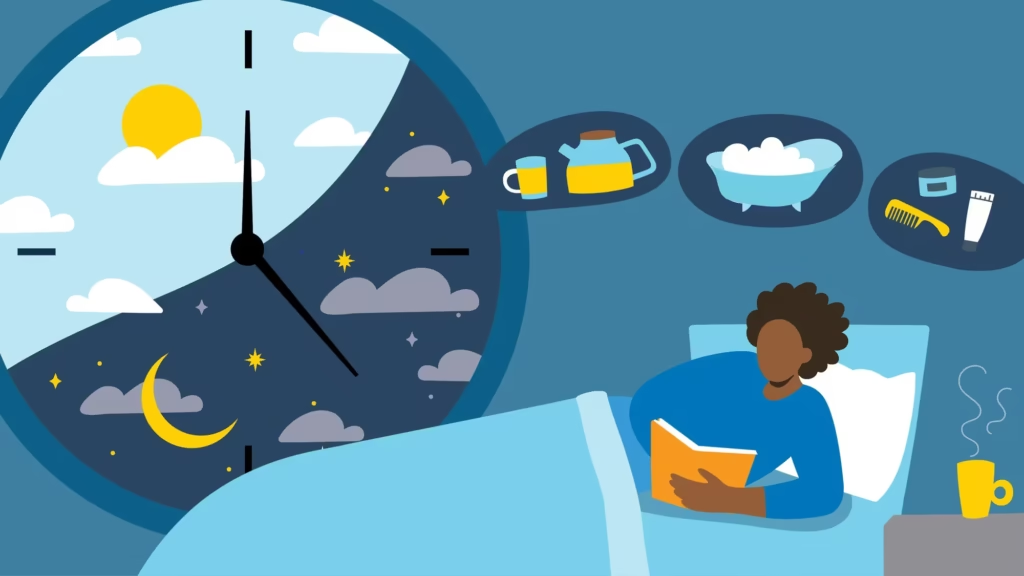
The temptation is enormous: sleep “normal” hours, stay up late, socialize, flip back to a day schedule for two days. Then struggle to settle back in when the next shift begins.
It’s known as “social jet lag,” and it’s a primary contributor to chronic fatigue in shift workers. Every time you flip your sleep schedule back and forth, it’s like flying from New York to London and back — every week.
What to Do on Days Off Without Destroying Your Schedule
| Option | What to Do | Best For |
|---|---|---|
| Stay on schedule | Keep same sleep/wake times on days off | Workers with consistent shift schedules |
| Gradual shift | Move sleep time 1–2 hrs toward day schedule, then back | When some social flexibility is needed |
| Anchor sleep | Keep at least 4–5 hours overlapping your work-day window | Rotating shift workers |
Discuss your schedule with the people in your life. Family and friends who understand that your “sleeping time” is sacred will be far less likely to call, knock, or plan things during your sleep window.
Put a polite note on your door during sleep hours: “Night shift worker sleeping — back at [time].” It works better than you might think.
How These 9 Strategies Work Together
Each of the strategies in this NightShiftLiving guide works well on its own. But they are meant to function as a system. Here is how they address the three main challenges night shift workers face:
| Core Problem | Primary Strategies | Supporting Strategies |
|---|---|---|
| Can’t fall asleep after a shift | Light control, wind-down ritual, sleep environment | Caffeine cutoff, meal timing |
| Sleep is broken or too short | Consistent schedule, bedroom optimization, no alcohol | Exercise timing, screen limits |
| Fatigue during the shift | Strategic napping, pre-shift light exposure | Smart meal choices, exercise |
| Can’t recover on days off | Protecting your schedule, preventing social jet lag | All 9 strategies in combination |
Quick NightShiftLiving Sleep Score Checker
How many of these do you currently do? Count your score below.I go to bed and wake up at the same time every dayMy bedroom is dark (blackout curtains or sleep mask)I wear sunglasses on my commute home from workI cut off caffeine at least 6 hours before sleepI have a consistent wind-down routine before bedI take strategic naps before long shiftsNo screens 30 minutes before sleepI don’t exercise too close to when I need to sleepOn days off, I still protect my sleep schedule
Your score: 0/9 — Just getting started — pick 2 strategies to focus on this week.
Frequently Asked Questions
How long does it take to adapt to night shift sleep?▾
As a night shift worker, is it acceptable to sleep in two separate chunks?▾
Can melatonin help night shift workers sleep during the day?▾
How do you handle family and social obligations on a night shift schedule?▾
Is it possible to fully reset my body clock on days off?▾
Are sleeping aids safe for night shift workers?▾
What about changing shifts or rotating schedules?▾
The Bottom Line on NightShiftLiving
Working night shifts is genuinely tough on the body. That’s not a complaint — just science. Your biology is battling a timetable that goes against thousands of years of human evolution.
But hard doesn’t mean impossible. These 9 NightShiftLiving sleep strategies provide you with tangible, effective tools to fight back. Begin with two or three that seem most attainable. Build the habit. Then layer in more.
The aim is not perfect sleep — it’s consistently better sleep. That is what transforms exhaustion into energy, brain fog into clarity, and survival mode into sustainable living.
You chose this schedule for a reason. Give yourself the sleep system that helps you thrive in it.
Related Post

6 Simple NightShiftLiving Sleep Upgrades for Better Rest
Working nights flips your world upside down. While the rest of the city is winding…