Night Shift Living: 5 Productivity Boosters for Focus
>> Productivity NightShiftLiving>> Night Shift Living: 5 Productivity Boosters for Focus
Night Shift Living: 5 Productivity Boosters for Focus
Night work, however, is not for the feeble.
While the rest of the world is asleep, night shift employees are grinding through tasks and pushing back against fatigue, trying to stay mentally sharp. Nursing, telecommuting, freelancing, security detailing or just being someone who can’t seem to function until after the sun goes down — living a night shift life has some unique challenges most productivity advice completely misses.
Tips about “waking up early” and “morning routines” just don’t apply to you. You require tactics tailored to the nocturnal way of life.
That is precisely what this article provides.
So, just 5 secret productivity boosters for night shift living that work — as evidenced by actual night workers tested in the field, supported by sleep science when possible, and guaranteed to help you get more done while the world sleeps.
Why Most Productivity Tips Don’t Work for Night Shift Workers
Here’s the awkward reality: a lot of productivity content is designed for 9-to-5 people.
Morning cold plunges. Sunrise journaling. “Eat the frog before 8 AM.” None of that aligns with the experience of living a night shift lifestyle.
Night workers face a whole new set of issues. Their body clocks are at war with social norms, daylight schedules, and even their own biology. The circadian rhythm — the body’s 24-hour biological clock, which regulates sleep, energy, and mental alertness — is closely linked to sunlight.
Flipping that schedule on its head makes everything harder.
The good news, though, is that once you learn how your nocturnal biology works, you can hack it for advantage. The 5 boosters below do just that.
Booster #1 — Own Your Light Environment
Light is by far the most important tool for energy management in night shift life.
Light is the primary signal to your brain about whether it’s time for wakefulness or sleep. In particular, blue light — the type emitted by the sun, screens, and LED bulbs — suppresses melatonin, the hormone that induces sleepiness. Once you know this, you can use light intentionally.
Bright Light in Your “Morning” (Even If It Is 10 PM)
When you clock in for your night shift, treat it like your morning. Surround your workspace with bright, cool-toned light. Ideally use a daylight lamp (5000–6500K color temperature). This cues your brain that it is time to become alert and focused.
Even 20–30 minutes of early exposure to bright light can do wonders for your energy and mental clarity.
Block Out the Light When Your Shift Is Over
This is where the majority of night workers mess up. They come home as the sun is coming up, walk into a brightly lit kitchen, and wonder why they can’t sleep.
Invest in blackout curtains. Wear blue-light-blocking glasses on your commute home. Switch your phone screen to night mode before the shift is over. These small actions signal to your brain that sleep is near, not another day of productivity.
The Light Timing Cheat Sheet
| Time | Light Strategy | Why It Works |
|---|---|---|
| Start of shift | Bright white/blue light | Signals alertness, suppresses melatonin |
| Mid-shift slump | Brief bright light burst | Resets alertness for focus |
| 2 hours before end | Dim to warm/amber light | Prepares brain for wind-down |
| Commute home | Blue-light-blocking glasses | Stops melatonin suppression |
| Sleep environment | Total blackout | Triggers melatonin release |
Taking control of your light environment is the foundation of night shift living productivity. Everything else is built on top of it.
Booster #2 — Create a Sleep System That Truly Defends Your Rest
You can’t get much done if you’re operating on broken, fractured sleep.
Night shift workers normally sleep 1–4 fewer hours than day workers. That sleep debt compounds fast. One week of chronic sleep deprivation makes us nearly as cognitively impaired as being legally drunk.
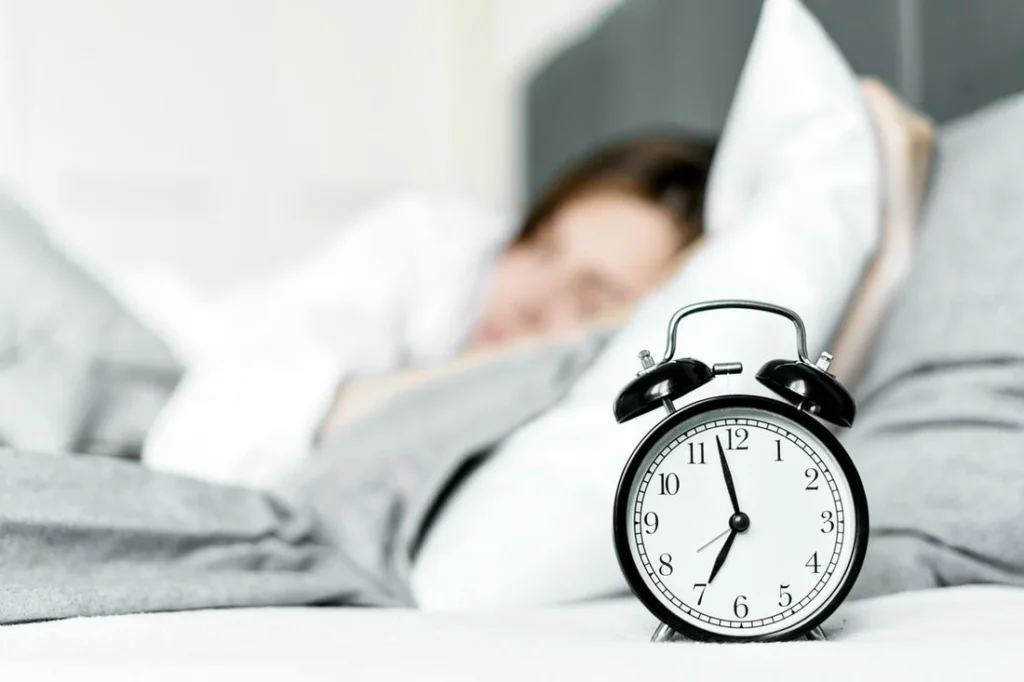
But you can be more deliberate with how you arrange your sleep around night shift life.
The Anchor Sleep + Strategic Nap System
If you can’t sleep in one long block because of your schedule, don’t try. Instead, use a two-part system:
Anchor sleep: A solid 4–6 hour sleep block immediately after the end of your shift. This captures your deepest, most restorative sleep stages.
Strategic nap: A 90-minute nap 1–2 hours before your next shift starts. This tops up your alertness and helps you get into peak focus mode for the shift ahead.
This method — known as “split sleep” — is used by military personnel, long-haul pilots, and emergency responders.
Create a Wind-Down Ritual
Your brain needs transition time. It can’t switch from “work mode” to “sleep mode” in five minutes.
Create a 30-minute wind-down routine before your anchor sleep:
- Dim all lights in your home
- Do something calming and repetitive (reading, light stretching, a warm shower)
- Stay away from screens, or use full night mode
- Keep your sleep environment at 65–68°F (18–20°C) — cooler temperatures activate the body’s natural sleep response
A consistent wind-down ritual is one of the most underrated night shift living productivity hacks because it protects the quality of sleep you do manage to get.
Sleep Hygiene Quick Reference
| Habit | Do This | Avoid This |
|---|---|---|
| Noise management | White noise machine, earplugs | Silence (too easy to wake from) |
| Temperature | Cool room (65–68°F) | Warm or fluctuating temp |
| Timing consistency | Same sleep time daily | Random sleep schedules |
| Pre-sleep screen use | Night mode, low brightness | Bright screens at full brightness |
| Caffeine cutoff | 6+ hours before sleep | Caffeine within 4 hours of sleep |
Booster #3 — Create a Focus Ritual That Switches Your Brain Into Work Mode
This is the booster that almost all night shift workers are missing out on entirely.
The human brain loves patterns. By repeating the same sequence of actions before a focused task, you train your brain to associate that sequence with deep work. As time passes, the ritual itself becomes a trigger.
Psychologists call this a “pre-performance routine.” Athletes use them. Top performers swear by them. And for night shift living, they are vital.
What Goes into a Night Focus Ritual?
A focus ritual doesn’t have to be complicated. It just has to be consistent. Here’s a simple 10-minute version:
- Get your drink (coffee, tea, whatever your fuel is)
- Take 2 minutes to skim your task list for the shift
- Put on your chosen focus music or ambient sound
- Set your phone to Do Not Disturb and place it out of arm’s reach
- Take 5 deep breaths and set your first intention: “I am working on X for the next 90 minutes.”
That’s it. Do the same sequence every single shift, and within 2–3 weeks just starting step one will trigger your focus state automatically.
Time Blocking for Overnight Schedules
Not every hour of your night shift is created equal. According to research on circadian rhythms — including findings from the National Sleep Foundation — night workers have a natural peak of alertness in the initial part of their shift (the first 2–3 hours) and experience a biological drop around 3–5 AM.
Time blocking helps you align your tasks with your energy:
| Energy Level | Best Time in Shift | Task Type |
|---|---|---|
| Peak focus | First 2–3 hours | Complex thinking, writing, analysis |
| Moderate | Mid-shift | Meetings, emails, routine work |
| Low (slump) | 3–5 AM window | Light admin, filing, restocking |
| Recovery | Final 1–2 hours | Creative tasks, planning for next shift |
This is one of the most effective night shift living strategies because it stops you from fighting your own biology. Instead, you surf it.
The Pomodoro Method, Night Shift Style
The standard Pomodoro technique (25 minutes of work, 5-minute break) can be adjusted to suit the night shift lifestyle.
Night workers often need longer warm-up periods. Try this instead:
- 90-minute deep work blocks (ultradian rhythm cycles)
- 15-minute active breaks (walk, stretch, light snack)
- No more than 2 deep blocks per shift
This keeps cognitive fatigue low and focus high throughout the night.
Booster #4 — Feed Your Brain With Night-Specific Nutrition
Your choices around food and drink during your shift massively impact the way you think and focus.
The trouble is, most “healthy eating” guidance is designed around daytime eating patterns. Your digestive system has a circadian rhythm, just like your brain. Its purpose is to efficiently process food during the day, then slow down at night.
Consuming large meals in the middle of the night forces your body to dedicate energy toward digestion — precisely when you need that energy for thinking.
The Night Shift Eating Formula
Here is a simple formula for night shift nutrition:
Before your shift: Eat a balanced, moderate-sized meal consisting of protein, healthy fat, and complex carbs. This is your base fuel load.
During your shift: Snack small and light every 2–3 hours. Choose protein and fiber-rich foods that digest slowly, so you don’t experience energy spikes and crashes.
After your shift (before sleep): Keep it light. A small protein-rich snack — Greek yogurt or a handful of nuts — is fine. Avoid heavy meals within 2 hours of going to sleep.
Best Foods for Night Shift Focus
| Category | Good Options | Avoid |
|---|---|---|
| Protein | Eggs, turkey, cottage cheese, nuts | Greasy fried proteins |
| Carbs | Oats, sweet potato, whole grain crackers | White bread, sugary pastries |
| Hydration | Water, herbal tea, electrolytes | Sugary sodas, energy drinks |
| Caffeine | Black coffee, green tea (first half of shift) | Caffeine in final 6 hours of shift |
| Snacks | Apple + almond butter, hummus + veggies | Chips, candy bars, vending machine food |
The Caffeine Timing Rule for Night Workers
The half-life of caffeine is around 5–7 hours. That means coffee consumed at 4 AM still has half of that caffeine active in your system by 9–11 AM when you’re trying to sleep.
A smart caffeine strategy for night shift living looks like this:
- First coffee: at the beginning of your shift
- Second coffee (if necessary): by the halfway point of your shift
- Zero caffeine after that — switch to water or herbal tea
Simply following this one rule can dramatically improve your post-shift sleep quality — and the better you sleep, the more focused you’ll be for your next shift.
Booster #5 — Protect Your Mental Energy by Fixing the Isolation Problem
This one isn’t often covered in the night shift living conversation.
The fact of working while the world sleeps presents a unique psychological obstacle: isolation. People are social creatures, and being on a schedule that is out of sync with everyone else for weeks or months takes a heavy toll on motivation, mood, and focus.

Research consistently finds that social isolation leads to poorer cognitive ability, higher rates of depression, and lower work quality. For night shift workers, this is not just a “feelings” problem — it directly impacts productivity.
Build Your Night Shift Social Infrastructure
The goal is not to force socializing. It’s about designing small, regular points of connection into your routine so that isolation doesn’t compound.
Start-of-shift check-in: Even a 3-minute text exchange with a friend, partner, or coworker before your shift starts creates a sense of connection and purpose.
Online communities: There are entire online communities dedicated to night shift living — forums, Discord servers, Reddit communities. Being among other people on the same schedule removes the “I’m the only one” feeling that drains your energy.
End-of-shift debrief: Write a short 3-sentence journal entry at the end of every shift: what got done, what felt hard, what you’re proud of. This creates a sense of completion and self-acknowledgment — especially when there is no one awake to say “good job.”
Set Boundaries With Your Daytime World
The daytime world has its own pressures that can drain a night shift worker’s energy. Family calling during sleep hours. Social events scheduled for Saturday morning. Friends who ask why you can’t “just wake up earlier.”
Setting clear, calm boundaries about your schedule is a productivity booster because it protects your recovery time and stops the guilt spiral of feeling like you’re “missing out.”
A simple script: “I work nights, so I sleep mornings. I’m always free after [X time]. Can we make plans then?”
The Night Shift Mental Energy Matrix
| Threat to Energy | Source | Night-Specific Fix |
|---|---|---|
| Isolation | No social contact | Join a night shift community |
| Schedule guilt | Social pressure | Set firm, calm boundaries |
| Purpose deficit | Invisible effort | End-of-shift journaling |
| Mood dips | Low light exposure | Use a SAD lamp during shift |
| Motivation drops | Repetitive tasks | Rotate task types every 90 min |
How All Five Boosters Work Together
These five strategies are not stand-alone tips. They form a system.
Light control sets the foundation. Strategic sleep conserves your cognitive resources. Focus rituals trigger your deep work state on cue. Night nutrition powers your brain without the energy crash. And addressing isolation keeps your motivation and mood elevated enough that you can actually use the other four.
Run all five in parallel and the compounding effect is very real. Night shift workers who adopt even 3 of these 5 strategies consistently report feeling more alert, more in control, and more productive — without working longer hours.
Night shift living doesn’t have to mean grinding through fog. It can mean operating at a level most daytime workers never reach.
Night Shift Living & Productivity: FAQs
Q: How long does it take to get used to working night shifts? For most people, it takes between 1 and 3 weeks to fully adjust their circadian rhythm to a night shift schedule. Full adjustment may never come, however, without following a consistent sleep schedule and managing light exposure properly.
Q: Is it better to keep the same night shift schedule every day, even on days off? Yes. Consistency is key. Moving back to a daytime schedule on your days off — a phenomenon known as “social jetlag” — disrupts your circadian rhythm and makes every work night feel like the first night back.
Q: What’s the best way to deal with the 3 AM slump? The 3 AM slump is mostly biological. The most effective strategies are a short walk (even 5 minutes helps), a protein-based snack, a burst of bright light exposure, and temporarily switching to lower-priority tasks. Don’t fight it — route around it.
Q: Can exercise help with night shift productivity? Absolutely. Exercise is one of the most powerful tools for resetting your circadian rhythm and boosting alertness. Working out at the beginning of your shift plays a similar role to morning exercise for day-shift workers. Avoid vigorous exercise within 3 hours of your planned sleep time.
Q: How do I stop feeling so tired when I get home from a night shift? Feeling wired but exhausted after a night shift is very common. The answer is a consistent wind-down routine — dimming lights on the way home, cutting out blue light from screens, avoiding stimulating content, and going straight to bed at the same time every day. Your body will learn the signal over time.
Q: Should night shift workers use energy drinks? Energy drinks are not recommended. They typically contain very high amounts of caffeine and sugar that create a sharp energy spike followed by a hard crash — the exact opposite of the sustained focus you need during night shift living. Stick to moderate amounts of coffee or green tea in the first half of your shift.
Q: Does the type of work you do on a night shift affect how tired you get? Yes. Monotonous and repetitive tasks accelerate mental fatigue during nighttime hours. Mixing up your task types, toggling between mentally heavy and lighter work, and using the time-blocking system from Booster #3 all help significantly.
The Bottom Line
Night shift living is genuinely tough. Your biology, your social world, and most of the productivity advice you’ll ever come across all seem stacked against you.
But once you grasp how your nocturnal schedule impacts your brain and body, you can build a system that makes working overnight not just manageable — but exceptional.
Start with one booster. Master it. Then add the next.
Light control is the easiest entry point. Sleep architecture gives you the biggest single gain. Focus rituals compound over time. Nutrition smooths out the energy curve. And protecting your mental health through connection and clear boundaries holds the whole system together.
Related Post

9 Long Shift NightShift Living Productivity Practices
Not everyone can work the night shift. Your body fights you. Your family operates on…