

8 NightShiftLiving Health Tips to Keep Your Energy Strong
>> Health NightShiftLiving>> 8 NightShiftLiving Health Tips to Keep Your Energy Strong
8 NightShiftLiving Health Tips to Keep Your Energy Strong
One of the toughest things you can demand of your body is working nights. Your energy takes a nosedive at precisely the wrong moment. Your meals feel off. Your workouts feel impossible. And the world around you is not designed for your timetable.
But the truth is: low energy on night shift does not have to be a given.
The right NightShiftLiving health tips — applied consistently — can make all the difference. Not just how you feel at 3 AM on the job, but how you recover, eat, move, and what your body endures over decades of shift work.
In this guide you’ll discover 8 simple, actionable tips to help address the real reasons behind your night-shift energy drain. All of them are science-backed and designed for real shift workers — not textbook theories.
What Night Shift Actually Does to Your Body
Before getting into the tips, it helps to know why exactly night-shift work drains your energy so consistently.
Your body operates on a circadian rhythm — a 24-hour internal clock. It governs energy, digestion, hormone release, and cell repair. It’s meant to keep you alert during the day and regenerate your body at night.
When you turn your schedule upside down, everything shifts — but not in a good way.
How night shift disrupts your body systems
⚡
Energy hormones: Cortisol (the “get up and go” hormone) is highest in the morning. On night shift, you’re combating this peak when you’re trying to sleep.
🍽️
Digestion: Your gastrointestinal tract slows down at night. Eating during your shift forces food into an inefficient processing system.
🧠
Brain performance: Between 2 AM and 6 AM, cognitive function, reaction time, and decision-making all take a major hit.
💪
Muscle recovery: Growth hormone — which heals muscles — is secreted during nighttime sleep. You produce less of it during daytime sleep.
❤️
Heart and metabolism: Long-term shift work increases the risk of heart disease, type 2 diabetes, and obesity if energy and health habits are neglected.
The good news? All of these disruptions can be addressed. You can’t alter your work schedule, but you can establish habits that work with your biology rather than against it.
And that’s exactly what these NightShiftLiving health tips are designed to do.
Tip #1 — Eat When Your Shift Is, Not When the Clock on the Wall Says
NightShiftLiving Health Tip 1
Most guidance on nutrition is framed for a 9-to-5 world. “Eat breakfast,” “eat dinner at 6 PM,” “don’t eat after 8 PM.” None of that applies to you.
If you eat like everyone else, your gut — already running on its own nighttime slowdown — will struggle to process it. The result is bloating, lethargy, and energy crashes halfway through your shift.
Plan meals around your shift, not the calendar
Consider your “morning” as the hour leading up to your shift. That’s when you want to eat your biggest, most nutrient-dense meal. This is your version of breakfast — it prepares your body for the work ahead.
What to eat and when
| Timing | What to eat | Why it helps |
|---|---|---|
| 1–2 hrs before shift | Complex carbs + lean protein — rice, chicken, eggs | Stable energy release for the first half of shift |
| Mid-shift snack | Light snack — fruit, nuts, yogurt | Steady blood sugar without overloading digestion |
| Post-shift meal | Light, easy-to-digest foods (soup, toast, or a banana) | Doesn’t disrupt sleep with heavy digestion |
| Avoid at all times | Greasy, fried, or sugary processed food during shift | Energy spikes and crashes; sluggish gut |
Pro tip: Prepare your shift meals ahead of time. When you’re tired after a shift, a ready meal prevents you from reaching for the most readily available (worst) option.
Tip #2 — Hydration Is Your Silent Energy Switch
NightShiftLiving Health Tip 2
Dehydration is one of the most neglected causes of fatigue among night-shift workers. Even mild dehydration — as little as 1–2% of body weight — can impair concentration, increase tiredness, and make your brain feel foggy.
The problem? Shift workers tend to forget to drink water because there are no meal cues to remind them — and they use coffee as a crutch instead.
How much water do you actually need?
Most adults require approximately 2–3 liters (8–12 cups) of water daily. During night shift, aim to get at least 500 ml (2 cups) in the first hour of your shift and drink consistently throughout.
Simple hydration rules for night shift
- Drink a full 500 ml bottle of water before your first coffee at the start of every shift
- Set a phone reminder every 90 minutes to take a water break
- Eat water-rich foods — cucumber, melon, oranges, soups — as part of your shift snacks
- Stick to 2–3 caffeinated beverages per shift (each cup of coffee has a mild diuretic effect)
- Stay away from sugary energy drinks — they cause a sudden blood sugar spike followed by a hard crash
Warning: If your urine is dark yellow or amber mid-shift, you are already dehydrated. Pale yellow is the goal. Dark urine is your body’s SOS signal.
Hydration vs. coffee — knowing the difference
Coffee feels like energy. Water creates energy. Caffeine works by blocking adenosine — the chemical that makes you sleepy. It doesn’t generate energy; it borrows it. Water sustains every cell, every organ, and every chemical process in your body. You need both, but there is a hierarchy: water comes first.
According to the National Institute for Occupational Safety and Health (NIOSH), shift workers are at increased risk for fatigue-related health problems — and hydration is one of the simplest and most effective countermeasures available.
Tip #3 — Move Your Body During the Shift, Not Just After
NightShiftLiving Health Tip 3
Most shift workers think of exercise as something that happens before or after work. But one of the most powerful NightShiftLiving health tips is this: movement during your shift is one of the quickest ways to combat the 3 AM energy wall.
Why in-shift movement works
When you sit still for long stretches, blood pools in your lower body, oxygen delivery to the brain decreases, and your body interprets stillness as a signal that it’s time to sleep. Even a short 5-minute walk immediately disrupts this cycle.
Research suggests that brief bouts of activity during night shifts — even just walking — significantly improve alertness, mood, and performance in the hours that follow.
The shift movement menu
Every break (5–10 min)
Walk the floor, climb stairs, or do light stretches at your workstation
Mid-shift low point (2–4 AM)
10 jumping jacks, 10 squats, or a brisk 5-min walk to reset alertness
Before shift (30–45 min out)
Moderate cardio or strength training — energizes and primes alertness for hours
After shift (not right before sleep)
Light yoga or walking only — intense workouts within 2 hours of sleep impede rest
Key insight: The goal isn’t gym-level workouts on shift. It’s breaking up stillness every 60–90 minutes. This keeps your circulation moving, your brain oxygenated, and your energy from crashing.
Tip #4 — Treat Sleep Like Your Most Valuable Asset
NightShiftLiving Health Tip 4
If your daytime sleep is fragmented, too short, or poor in quality, you will not have strong energy on night shift. Sleep isn’t a passive event — that’s when your body replenishes everything it used up during the shift.

One of the most fundamental NightShiftLiving health tips: treat your sleep window with the same seriousness you treat your shift schedule.
The three pillars of quality daytime sleep
| Pillar | What to do | Impact on energy |
|---|---|---|
| Darkness | Full blackout curtains, sleep mask, tape over LED lights | Triggers melatonin; enables deep sleep cycles |
| Silence | White or pink noise machine, ear plugs as backup | Prevents cortisol spikes from sudden sounds |
| Consistency | Same sleep and wake time every day, even on days off | Trains circadian rhythm for faster sleep onset |
Critical: Getting less than 6 hours of sleep before a night shift drastically reduces decision-making, slows reaction time, and impairs emotional control — equivalent in some studies to being legally drunk.
Tip #5 — Nail Your Supplement Game for Night-Shift Bodies
NightShiftLiving Health Tip 5
Night-shift workers are at greater risk for certain nutrient deficiencies — due to lifestyle alone. No sunlight means low vitamin D. Disrupted digestion means poor nutrient absorption. High stress hormones burn through magnesium and B vitamins at a quicker pace.
Supplements won’t replace good food or sleep. But the right ones, taken correctly, fill real gaps.
The core four supplements for shift workers
| Supplement | What it does | Best time to take | Why shift workers need it |
|---|---|---|---|
| Vitamin D3 | Supports energy, immunity, mood | With your first meal of the day | No sun exposure during waking hours |
| Magnesium glycinate | Reduces muscle fatigue, aids sleep | 30–60 min before sleep | Stress burns through magnesium fast |
| Vitamin B12 | Directly powers cellular energy | Morning (your pre-shift) | Low absorption from disrupted digestion |
| Omega-3 fish oil | Reduces inflammation, supports brain | With a meal containing fat | Counters systemic inflammation from shift stress |
Always consult your doctor before taking supplements. Dosage and individual needs vary greatly. Certain supplements may interact with medications or pre-existing conditions.
What about melatonin?
Melatonin (0.5–1 mg) taken 30 minutes before your sleep window can help your body recognize it’s time to rest. It’s most effective at helping you fall asleep, not at improving sleep quality overall. Keep the dose low — high doses can cause grogginess and interfere with natural hormone production over time.
Tip #6 — Manage Stress Before It Manages You
NightShiftLiving Health Tip 6
Stress is one of the biggest hidden energy drains for shift workers. And it’s not just job stress — it’s the chronic, background stress of living in opposition to your biology.
When cortisol (your stress hormone) is allowed to linger too long, it drills holes in your energy reserves. It interferes with sleep, degrades muscle, elevates blood pressure, and leaves you wired but exhausted — a state that shift workers know all too well.
Why shift workers carry more stress
- Sleep deprivation directly elevates cortisol levels
- Social isolation from family and friends on opposite schedules
- Physical stress created by constantly adjusting the body clock
- Irregular eating times affect gut bacteria, which influence mood and stress response
Practical stress-reset techniques for shift workers
Box breathing
Inhale 4 sec, hold 4, exhale 4, hold 4. Do 4–6 cycles. Instantly activates the calm-down nervous system.
5-minute journaling
Write 3 things you’re grateful for before sleep. Shifts brain chemistry away from stress.
Social connection
A 10-minute conversation with a loved one reduces cortisol more than almost anything else.
Nature exposure
Even 10–15 minutes outside — even after your shift — reduces stress hormones in measurable ways.
Shift worker reality check: You don’t need 30-minute meditation sessions. Even 5 minutes of intentional breathing or stillness between high-stress moments resets your cortisol curve in a meaningful way.
Tip #7 — Build an Energizing Pre-Shift Routine
NightShiftLiving Health Tip 7
The way you spend the 60–90 minutes before your shift has a huge effect on how you feel for the next 8–12 hours. Most shift workers crawl out of bed, down a coffee, and race to work. That’s a formula for running on fumes by midnight.
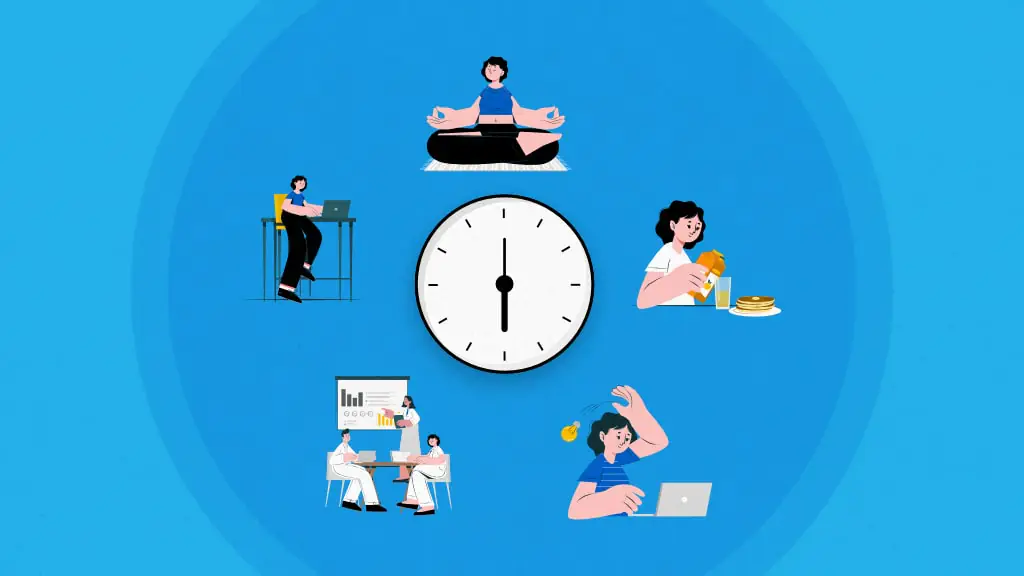
A structured pre-shift routine is one of the most underused NightShiftLiving health tips. It preps your brain, body, and energy systems before the demand arrives.
What a strong pre-shift routine looks like
| Time before shift | Activity | Energy benefit |
|---|---|---|
| 90 min before | Wake up gently — no alarm snooze, no phone for 10 min | Prevents cortisol spike from a jarring wakeup |
| 75 min before | Eat your pre-shift meal (complex carbs + protein) | Stabilizes blood sugar for the first 4–5 hours |
| 60 min before | Light exercise or brisk walk (20–30 min) | Increases alertness, boosts dopamine |
| 30 min before | Cold or cool shower | Activates the nervous system, sharpens focus |
| 15 min before | First coffee or tea (not an energy drink) | Caffeine peaks right as your shift starts |
| 5 min before | Review your plan and priorities for the shift | Mental readiness reduces shift anxiety |
The trick is making this routine feel automatic. It shouldn’t require willpower. After 2–3 weeks of consistency, your body will start waking up “ready” because it knows what’s coming.
Tip #8 — Guard Your Mental Health — Energy Lives There Too
NightShiftLiving Health Tip 8
Physical health and mental health are not separate when it comes to energy. Shift workers are considerably more likely than day workers to experience depression, anxiety, and emotional burnout — and these conditions drain energy just as powerfully as any physical illness.
This is the NightShiftLiving health tip most people skip. Don’t skip it.
The psychological cost of shift work
Working while the rest of the world sleeps creates a quiet kind of isolation. You miss birthdays, dinners, and mornings with your family. Your social circle feels out of reach. Over time, this wears on you.
Factor in chronic sleep disruption — which directly depletes serotonin and dopamine — and the emotional burden becomes significant.
Signs your mental energy is running low
😶
Feeling emotionally flat or numb, even on days off
😤
Irritability or short temper that wasn’t present before
🧱
Dreading your shifts more than usual, even without a concrete cause
🌀
Feeling like you’re “just getting through” every shift with nothing left over
📉
Loss of interest in hobbies, social activities, or things you used to enjoy
What actually helps
- Build social rituals that work within your schedule — a weekly call, a shared meal on a day off
- Talk to someone — a friend, family member, or professional — before it grows into something bigger
- Protect your days off as genuine recovery days, not just errand days
- Connect with other shift workers — communities like NightShiftLiving exist because the experience is shared and support matters
- If symptoms persist, speak to a doctor — shift-work-related depression is real and treatable
A reminder: asking for help is not weakness. It’s one of the least energy-consuming choices you can make. Carrying a mental health problem alone burns far more energy than addressing it.
How All 8 Tips Work Together
Energy on night shift is not one problem with one solution. It’s a system. Consider these 8 NightShiftLiving health tips as levers — each one moves the needle, but together they can help you feel and function like a completely different person.
Nutrition
88
Hydration
82
Movement
79
Sleep
95
Supplements
68
Stress mgmt
75
Pre-shift routine
84
Mental health
77
| Health tip | Primary energy benefit | Time to see results |
|---|---|---|
| 1. Shift-based nutrition | Stable blood sugar, no energy crashes | 2–5 days |
| 2. Hydration | Sharper thinking, less fatigue | First shift |
| 3. In-shift movement | Beats the 3 AM energy wall | Same shift |
| 4. Sleep protection | Full energy restoration between shifts | 3–7 days |
| 5. Key supplements | Fills deficiency gaps, supports systems | 2–4 weeks |
| 6. Stress management | Reduces cortisol, defends energy reserves | 1–2 weeks |
| 7. Pre-shift routine | Arrives ready, not already depleted | 1–2 weeks |
| 8. Mental health care | Sustains motivation and emotional energy | Ongoing |
Frequently Asked Questions
What should you eat on a night shift to sustain energy?
Eat food that slowly releases energy. Complex carbs — oats, brown rice, sweet potatoes — paired with a lean protein (eggs, chicken, legumes) stabilize blood sugar for hours. Steer clear of sugary snacks — the energy spike is short and the crash is brutal. A small handful of nuts, a banana, or Greek yogurt make ideal mid-shift snacks.
How can night-shift workers stay healthy long-term?
Long-term night-shift health boils down to three pillars: consistent quality sleep, smart nutrition aligned with your schedule, and regular physical activity. On top of that, checking your vitamin D levels, having regular health check-ups, and actively protecting your mental health all make a big impact over months and years of shift work.
Can you have a normal social life working nights?
Yes, but it takes communication and creativity. Be honest with friends and family about your schedule. Find “overlap windows” — afternoons are often fruitful. Weekend schedules may allow some evening socializing. Quality matters more than quantity — 2 meaningful social interactions per week does more for your mental energy than trying to maintain a full day-shift social calendar.
Does exercise before a night shift help or hurt?
Light to moderate exercise 1–2 hours before your shift dramatically increases alertness, mood, and cognitive performance. It boosts dopamine and norepinephrine — your brain’s “get to work” chemicals. However, avoid intense training within 90 minutes of your shift start time, as it elevates cortisol and body temperature in ways that can initially make you feel more fatigued.
What vitamins should night-shift workers take?
The most important are vitamin D3 (due to lack of sunlight), magnesium glycinate (supports sleep and reduces fatigue), vitamin B12 (directly involved in energy production), and omega-3 fatty acids (reduce inflammation from shift stress). Always consult a doctor before starting any supplement regimen, as needs vary by individual and existing health conditions.
How do I stop crashing at 3 AM on night shift?
The 3 AM crash is caused by your circadian rhythm hitting its lowest point — and it’s worsened by sitting still, eating heavy food, and relying solely on caffeine. Combat it with physical movement (even 5–10 minutes), a small light snack, cold water, bright light exposure, and strategic caffeine timed to peak around 2–3 AM rather than earlier.
Can night-shift workers build muscle and stay fit?
Absolutely — but timing matters. Schedule your workouts for when you’d naturally feel at your peak (your version of mid-morning). Protein intake immediately after training is even more important for shift workers, as growth hormone release during daytime sleep is lower. Consistency beats intensity — 3–4 moderate workouts per week will build and maintain fitness far better than occasional intense sessions.
The bottom line
Night-shift work demands more from your body than almost any other lifestyle. But strong, reliable energy on night shift is not a fantasy — it’s the result of the right habits, applied consistently.
These 8 NightShiftLiving health tips give you a complete framework. Start with the basics: eat smart before your shift, drink water before coffee, move your body every hour, and protect your sleep window. Build from there.
You’re not just surviving night shift. With the right approach, you can genuinely thrive in it — feel sharp at 3 AM, recover fully between shifts, and protect your health for the long haul.
One habit at a time. One shift at a time.
Related Post

6 Health Hacks for Better Immunity with Smart NightShiftLiving
Something sneaky happens to your body when you work the night shift. It doesn't only…